
The Pisa Cathedral (Duomo): A Complete Guide
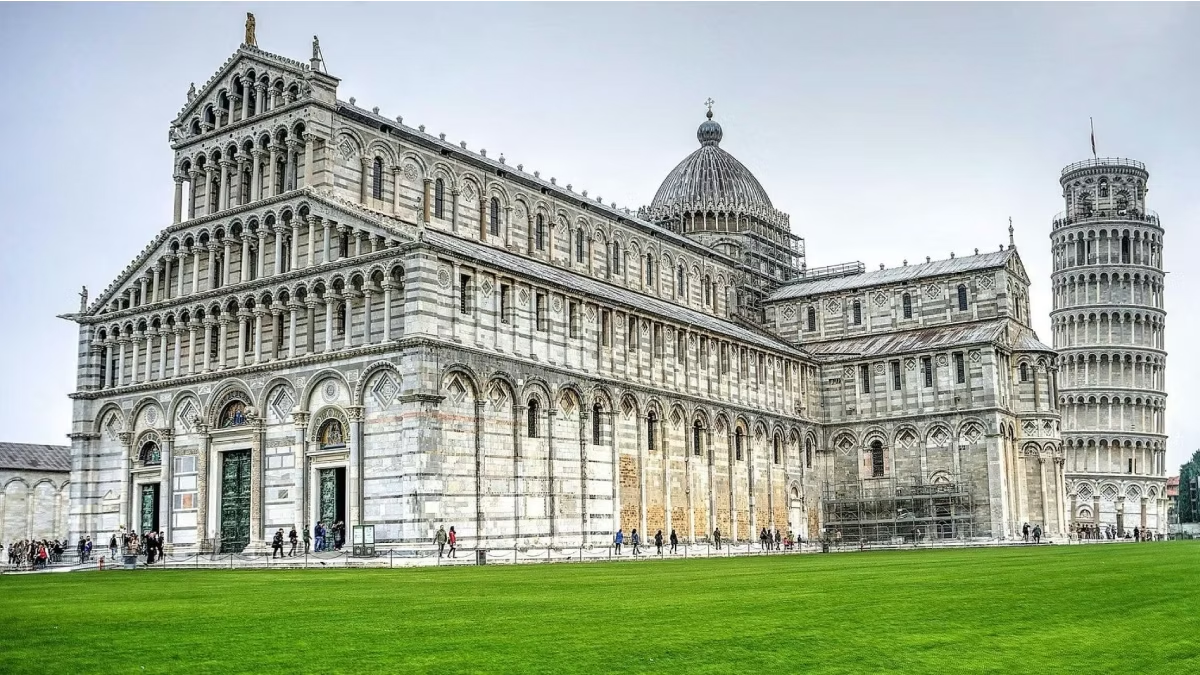
The Pisa Cathedral (Duomo di Pisa) is free to enter but requires a ticket — a free pass collected at the ticket office, or included automatically with any paid monument ticket. It opens at 10:00 AM daily. The interior contains Giovanni Pisano’s carved pulpit (1302–1310), a Byzantine apse mosaic, Galileo’s Lamp, and the relics of San Ranieri, Pisa’s patron saint. Allow 45–60 minutes for a full visit.
The Cathedral of Santa Maria Assunta is the oldest and largest building in Piazza dei Miracoli, and by most architectural measures its most important. It predates the Baptistery, the Tower, and the Camposanto by decades, and its construction established the Pisan Romanesque style — a synthesis of classical, Byzantine, Lombard, and Islamic influences — that would shape religious architecture across Tuscany and Sardinia for the next century. Despite being overshadowed in popular imagination by the famous leaning bell tower at its back, the Cathedral is an extraordinary building with its own remarkable stories.
History
The 1063 campaign and its legacy Construction of the Cathedral began in 1064. It was funded directly by the spoils of Pisa’s successful naval campaign against the Arab forces at Palermo in 1063. The victory was significant for the Christian kingdoms of the Mediterranean, and Pisa — which provided decisive naval support — returned with an enormous quantity of treasure. The decision to invest this wealth in a great cathedral was a statement of power, gratitude, and religious ambition.
The architect Buscheto created an original synthesis that drew on the full range of architectural traditions the Pisan maritime fleet had encountered across the Mediterranean. The pointed arches and elliptical dome reflect Moorish influence. The raised matronea galleries above the side aisles show Byzantine precedent. The use of alternating coloured marble bands in horizontal stripes is a Lombard element. The overall scale and grandeur are classical in ambition. The result was a new architectural language — Pisan Romanesque — that spread from Pisa to Lucca, Pistoia, and the Pisan colonies in Sardinia.
Enlargements and the fire of 1595 The Cathedral was consecrated in 1118 by Pope Gelasius II, at which point it was the largest cathedral in Europe. A new facade was added in the 12th century with four tiers of colonnaded galleries. Enlargements continued through the 14th century. In 1595, a fire devastated the interior, destroying most of the medieval frescoes and decorations. The coffered wooden ceiling visible today replaced the original timber roof after the fire.
Architecture
The Cathedral is built in Pisan Romanesque style — a synthesis of classical, Byzantine, Lombard, and Islamic architectural influences. Its five-nave interior features monolithic granite columns from the Isle of Elba, alternating black-and-white marble striping, and an elliptical dome above the crossing.
The Exterior The west facade — facing the Baptistery — is the most photogenic side, with its four tiers of blind arcading in alternating black and white marble, blind arcades at the base, and a series of mosaics in the lunettes above the three central portals representing the Assumption of the Virgin, St. Reparata, and St. John the Baptist.
The three bronze entrance doors are by Bonanno Pisano (1180) and depict scenes from the life of Christ and the Virgin. On the south side, the Porta di San Ranieri faces the Leaning Tower — this is the entrance used by most visitors. Its bronze doors are richly decorated with reliefs.
Look for the bronze griffin on the roof ridge — a piece of Islamic metalwork, probably captured as war booty, that perched on the Cathedral roof for centuries as a symbol of Pisan naval dominance. The original is now in the Opera del Duomo Museum; the roofline currently shows a reproduction.
The Interior The Cathedral’s plan is a Latin cross with five naves in the main body and three in the transept and apse. At the crossing, an elliptical dome rises on an Ottoman-influenced plan, its inner surface decorated with 17th-century frescoes that replaced the medieval ones lost in the 1595 fire.
The nave columns are monolithic shafts of granite quarried from the Isle of Elba — each a single piece of stone — supporting round arches with the characteristic alternating black and white marble striping. Above the side aisles, women’s galleries (matronea) with solid columns run the full length of the nave. The spatial effect — the long perspective, the rhythmic striping, the scale — is genuinely imposing.
What to See Inside
Priority targets: Giovanni Pisano’s pulpit (1302–1310) with ~400 carved figures across nine narrative panels; the Christ in Majesty Byzantine mosaic in the apse (with a figure by Cimabue); Galileo’s Lamp at the nave crossing; and the glass-sided tomb of San Ranieri in the left transept chapel.
Giovanni Pisano’s Pulpit (1302–1310) The Cathedral’s undisputed artistic masterpiece. Giovanni Pisano spent eight years carving this extraordinary structure, supported by eleven elements including figurative caryatids representing Virtues and Evangelists. The nine narrative relief panels — depicting the Annunciation, Nativity, Adoration of the Magi, Presentation at the Temple, Flight into Egypt, Massacre of the Innocents, Kiss of Judas/The Arrest, The Crucifixion, and The Last Judgement — contain approximately 400 carved figures. The slightly curved panels were an unprecedented innovation, giving the pulpit an almost circular feel.
The pulpit was dismantled in 1599 (for reasons that remain unclear) and not reassembled until 1926 — and that reassembly was imperfect, with some original pieces missing and the parts not necessarily in their original positions. The missing staircase was not replaced.
Compare this pulpit with the earlier one by Nicola Pisano in the Baptistery across the square: the father’s work (1260) shows solidity and classical restraint; the son’s (1302–1310) shows drama, emotion, and movement. The transition between the two pulpits represents one of the most significant stylistic developments in medieval European sculpture.
The Christ in Majesty Mosaic In the apse conch — the curved surface above the altar — a large Byzantine mosaic depicts Christ in Majesty, flanked by the Virgin Mary and St. John the Evangelist. The figure of St. John was added around 1302 by Cimabue, the last major Byzantine painter and the teacher of Giotto. It is one of the few surviving works documented to Cimabue and the only one in Pisa.
Galileo’s Lamp Hanging from the ceiling at the nave crossing is a large bronze chandelier known as Galileo’s Lamp. According to the famous legend, the young Galileo (born in Pisa in 1564) was attending mass in the Cathedral when he observed a hanging lamp swinging in the wind and — timing its oscillations against his own pulse — discovered that the period of a pendulum’s swing is independent of its amplitude, regardless of how wide the arc. This became the law of isochronism, foundational to his later work on dynamics.
The chandelier visible today was cast after Galileo published his theory and is therefore not the lamp he supposedly observed. The original, smaller lamp is preserved in the Camposanto. Whether the pendulum experiment actually happened in the Cathedral is debated by historians; what is well documented is that Galileo studied pendulum motion extensively during his time in Pisa.
The Relics of San Ranieri San Ranieri is the patron saint of Pisa. A 12th-century merchant who renounced his wealth, spent years in the Holy Land in devotion, and returned to Pisa where he died in 1160. His mummified remains are housed in a glass-sided tomb in the chapel to the left of the main altar. A silver face mask, created following DNA facial reconstruction, is considered an accurate representation.
Every year on 16 June — the eve of the Feast of San Ranieri — Pisa holds the Luminaria: the city centre, including the Cathedral and Leaning Tower, is illuminated with thousands of candles in his honour. It is one of the most spectacular festivals in Tuscany.
The Tomb of Henry VII The fragmentary remains of the tomb of Holy Roman Emperor Henry VII, who died of malaria in 1313 while besieging Florence, are in the Cathedral. The original monumental tomb by Tino di Camaino was repeatedly dismantled and redistributed; the statue of the enthroned emperor is now in the Sinopie Museum.
The Devil’s Scratches On the north exterior wall of the Cathedral, at approximately eye level, is a piece of Roman marble with a series of small black marks. Legend holds these were made by the Devil when he attempted to climb the Cathedral dome to stop its construction. The legend adds that out of spite, the number of marks changes every time you count them.
Visiting Practical Information
Free entry with a pass. Passes are either included with any paid monument ticket or collected free from the ticket office on the day (limited, timed, first-come). Opens at 10:00 AM. Modest dress required. Photography permitted without flash.
Entry: Free, but a pass is required. If you have any paid monument ticket, Cathedral entry is automatically included. If you want Cathedral entry only, collect a free timed pass from any on-site ticket office on the day. Free passes are limited and issued first-come, first-served.
Opening hours: The Cathedral opens at 10:00 AM daily. It closes at 8:00 PM in peak season and earlier (around 6:00 PM) in winter. It may close briefly during religious ceremonies. Check opapisa.it for current seasonal hours.
Dress code: Modest dress is required — shoulders and knees must be covered. A shawl for the shoulders is available on-site if needed.
Photography: Permitted inside without flash.
Entrance: Visitors enter from the west door (facing the Baptistery). The Porta di San Ranieri on the south side (facing the Tower) is also used when access is managed.
Frequently Asked Questions
Is the Pisa Cathedral free to visit?
Yes — entry is free. However, you need a ticket: either a free pass collected from the on-site ticket office on the day (limited, timed, first-come first-served), or automatic inclusion with any paid monument ticket.
How long should I spend in the Cathedral?
Allow 45–60 minutes for a full visit, including time to examine Giovanni Pisano’s pulpit in detail, explore the nave, and visit the apse mosaic and San Ranieri’s chapel.
What is the most important thing to see in the Pisa Cathedral?
Giovanni Pisano’s carved pulpit (1302–1310) is the unrivalled artistic highlight — one of the masterpieces of medieval European sculpture.
Was Galileo really connected to the Cathedral?
Galileo was born in Pisa in 1564 and studied at the University of Pisa. The Cathedral’s connection to his pendulum theory is legendary but historically uncertain. What is well documented is that he conducted extensive pendulum experiments during his time in Pisa. The Cathedral’s chandelier is associated with his name regardless of the historical truth.
What style is the Pisa Cathedral?
Pisan Romanesque — a style created specifically for this building, blending classical, Byzantine, Lombard, and Islamic architectural elements. The Cathedral was the first expression of this style, which subsequently spread across Tuscany and Sardinia.
