
Leaning Tower of Pisa Architecture: Design, Style & Structure
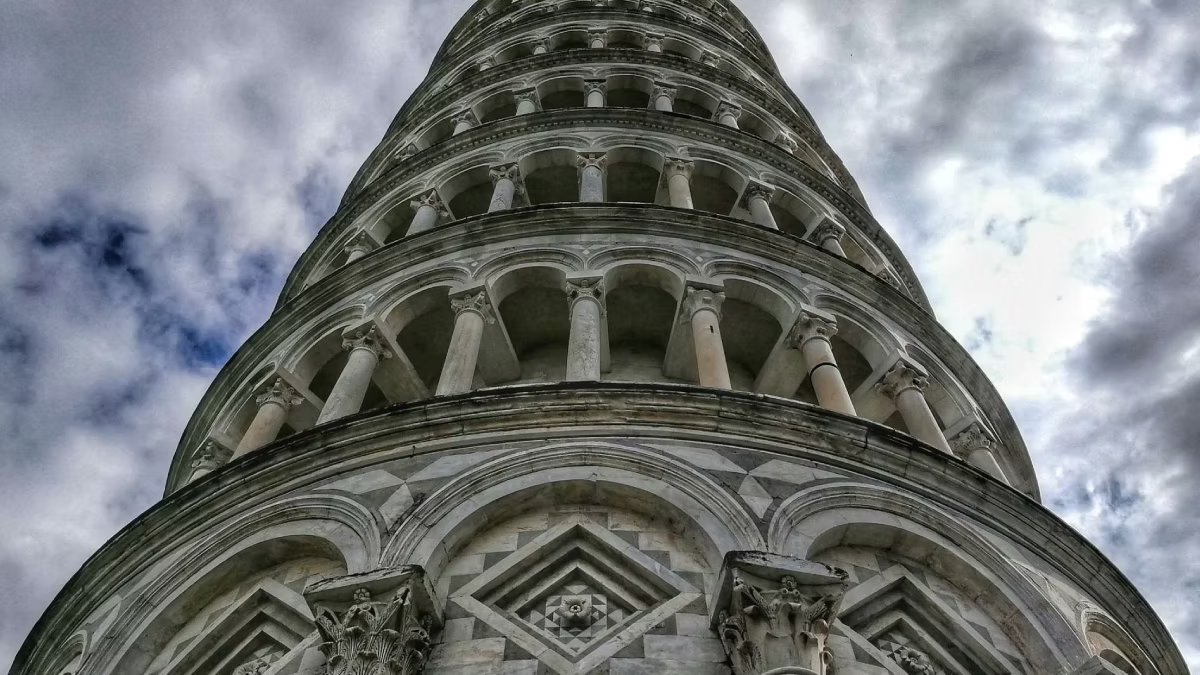
The Leaning Tower of Pisa is an eight-storey cylindrical campanile built in the Pisan Romanesque style. It stands 55.86–56.67 metres tall (varying due to the lean), weighs 14,500 tonnes, and is clad entirely in white and grey Carrara marble. The tower has 207 exterior marble columns arranged in six tiers of open arcade galleries, a ground floor of blind arcading, and a Gothic belfry chamber added in the 14th century. Its hollow cylindrical interior contains a three-section staircase with approximately 294 marble steps.
The Leaning Tower of Pisa is famous for its lean, but what it leans with is also remarkable — one of the finest expressions of Pisan Romanesque architecture in existence, a building that in a parallel world (one where the soil held firm) would be celebrated for its design rather than its accident. This guide explores the architecture of the Tower in detail: its stylistic context, its structural composition floor by floor, its materials, and the ways in which the lean itself shaped the building that exists today.
Architectural Style: Pisan Romanesque
Pisan Romanesque is characterised by colonnaded open-air loggias at each storey level, alternating white and grey Carrara marble, classical column capitals, and blind arcading at the base. It emerged in Pisa in the 11th century as a synthesis of classical, Byzantine, Lombard, and Islamic architectural traditions encountered through Pisan maritime trade.
The Tower is one of the purest expressions of Pisan Romanesque architecture — a style that emerged in Pisa in the 11th century as a synthesis of the architectural traditions encountered by Pisan merchants and sailors across the Mediterranean.
Romanesque architecture is broadly characterised by rounded arches, thick walls, and decorative arcading — a simplified inheritance from Roman architecture, filtered through centuries of early Christian and Byzantine development. What makes the Pisan variant distinctive is its specific combination of elements:
Colonnaded loggias — open-air arcaded galleries wrapping the exterior of the building at each storey level. These are the defining feature of the Tower’s silhouette and are characteristic of Pisan Romanesque buildings, distinguishing them from the more massive, wall-heavy Romanesque of northern Europe.
Alternating marble colours — the use of white and grey Carrara marble in the structural and decorative programme, a technique also seen on the Cathedral and Baptistery facades.
Classical column capitals — the columns supporting the arcade galleries have individually carved capitals in a Corinthian-derived style, connecting the Tower’s design vocabulary to the classical Roman tradition.
Blind arcading on the ground floor — a row of arches without openings, creating decorative rhythm at the base. This is consistent with the Cathedral’s treatment of its own lower storey.
The Pisan Romanesque style spread from Pisa across Tuscany and the Pisan maritime territories during the 12th and 13th centuries — to Lucca, Pistoia, and the churches of Sardinia and Corsica. The Tower was one of its earliest and most refined expressions.
The Architects and Their Contributions
Three architects shaped the Tower across its 199-year construction:
The original architect (1173–1178): The identity of the Tower’s first architect is disputed. The traditional attribution is to Bonanno Pisano; a 2001 study argued for Diotisalvi (who designed the Baptistery and other Pisan buildings). Giorgio Vasari cited Guglielmo and Bonanno jointly. The ground floor and the beginning of the first arcade belong to this phase.
Giovanni di Simone (1272–1284): Di Simone resumed construction after the first long pause and brought the Tower from three to seven storeys. His primary architectural challenge was the existing lean: he built the upper floors with one side deliberately higher than the other in an attempt to compensate, which introduced the Tower’s subtle curvature. Di Simone also designed the Camposanto next door. His work halted when Pisa lost the Battle of Meloria in 1284.
Tommaso di Andrea Pisano (1350–1372): Completed the seventh storey and added the belfry chamber. Tommaso’s work is notable for its successful stylistic reconciliation: he used lighter materials and slimmer columns in the belfry to reduce the weight burden on the already-leaning structure, while harmonising his Gothic belfry with the Romanesque character of the lower storeys.
Structural Composition: Floor by Floor
Eight storeys: a ground floor of 15 blind arches; six middle floors each with 30 open-air arcade columns (180 total); and a belfry chamber with 16 columns. Total: 207 exterior marble columns. Wall thickness at base: 2.44 metres. The Tower is hollow, with the staircase running up the inner face of the outer wall.
Ground Floor — Blind Arcade The base of the Tower presents a ring of 15 blind arches (arches without openings) surmounted by carved capitals. This ground floor is buried approximately 3 metres below the current ground level due to centuries of soil accumulation and the Tower’s own settlement. The original carved decoration at the very base of the building — including the intricately worked blind arcade — was only exposed after excavation work in 1838 (an intervention that, unfortunately, also increased the lean).
Floors 1–6 — Open Arcade Galleries Six storeys of open-air colonnade galleries, each supported by 30 marble columns. Each gallery is accessed from the interior staircase and wraps the full circumference of the Tower, allowing views outward at each level. The columns have round-arched openings above them and are topped by individually carved capitals. The gallery floors slope noticeably due to the lean, which becomes increasingly apparent with each storey climbed.
The total wall thickness at the base is 2.44 metres (8 feet). The exterior diameter of the Tower is approximately 15.5 metres; the inner diameter of the hollow core is approximately 7.4 metres.
Floor 7 — Upper Gallery and Transition The seventh floor marks the transition between the main body of the Tower and the belfry. It has fewer columns and a slightly different character, reflecting the change from Di Simone’s work to Tommaso Pisano’s completion.
Floor 8 — The Belfry Chamber The topmost chamber houses the seven bells and is surrounded by 16 columns — smaller and more slender than those on the lower floors, consistent with Tommaso Pisano’s strategy of reducing weight at the top. The belfry’s treatment is slightly Gothic in character — narrower arches, lighter members — creating a deliberate visual transition at the apex. The open gallery at belfry level is the destination of every visitor climb.
Materials
The Tower is clad entirely in white and grey Carrara marble — the same material used across all Piazza dei Miracoli monuments. The circular ring foundation is only 3 metres deep, set in soft alluvial soil — a critically inadequate depth for the structure’s 14,500-tonne weight.
White marble — the primary material throughout. The tower is clad in white Carrara marble quarried from the mountains near Carrara, approximately 60 kilometres north of Pisa. The same marble was used for all the monuments in Piazza dei Miracoli, giving the complex its characteristic gleaming white appearance.
Grey marble — used in alternating bands and decorative details, providing the visual rhythm of light-and-dark that characterises Pisan Romanesque buildings.
The foundation — the foundation is only 3 metres deep, an inadequate depth for the building’s weight on soft ground. It was laid as a circular ring foundation, not a solid raft, which contributed to the uneven settlement.
207 columns — the exterior galleries are supported by a total of 207 marble columns across all storeys: 15 on the ground floor, 30 on each of the six middle floors (180 total), and 16 in the belfry — giving 211 by strict count, though 207 is the commonly cited figure.
Decorative Details Worth Examining Up Close
Column capitals — Each of the 207 columns has an individually carved capital. No two are identical. The carving quality across the storeys reflects different phases of construction and different hands, but the overall programme maintains consistent Corinthian-derived forms.
Lozenge patterns — Diamond-shaped inlay patterns of alternating coloured stones are embedded in the facades between column levels. These catch the light and create a geometric pattern visible from the square.
The lean on the arcade floors — Standing on any gallery floor makes the lean physically apparent: the floor slopes noticeably away from horizontal. The columns on the downhill side are slightly taller than those on the uphill side — Di Simone’s structural compensation visible in the architecture.
The bells’ asymmetry — The seven bells in the belfry hang off-centre in their arched frames, the natural consequence of the Tower’s lean. A perfectly hung bell would be centred; these are visibly offset.
The Curve: Architecture Shaped by the Lean
The subtle banana-shaped curvature of the Tower’s upper storeys — where they bend slightly back against the lean direction — was introduced by Giovanni di Simone in 1272 as a structural compensation strategy. It is most visible from the north or south and is almost invisible from the standard east-facing tourist position.
The Tower’s subtle banana-shaped curvature — where the upper storeys bend slightly back against the lean — is one of its most architecturally unusual features. It arises from Di Simone’s compensation strategy: building the upper floors with one side taller than the other created a gentle counter-curve. This makes the Tower not a simple tilting tube, but a slightly curved structure that has been fighting its own lean for seven centuries.
The curvature is clearest when the Tower is viewed from the north or south (perpendicular to the lean direction) and is almost invisible when viewed from the east (the standard tourist position). It is one of the details that rewards a full walk around the exterior.
How the Architecture Relates to the Cathedral
The Tower was designed to complement the adjacent Cathedral, not merely to accompany it. The two buildings share a consistent decorative vocabulary — alternating marble stripes, colonnaded arcades, carved capitals, classical proportions — and are intended to be read as a compositional pair. The Tower’s colonnaded loggias echo the Cathedral’s multi-tiered facade galleries; both buildings use the same Carrara marble and the same Pisan Romanesque stylistic framework.
The relationship between the two buildings is most clearly seen from the elevated position of the Tower’s upper galleries, where looking west provides one of the finest close-range views of the Cathedral’s ornate marble roof and east transept facade — a perspective almost no visitor sees from ground level.
Frequently Asked Questions
What architectural style is the Leaning Tower of Pisa?
Pisan Romanesque — a local variant of Romanesque architecture developed in Pisa in the 11th century, characterised by colonnaded loggias, alternating marble colours, and classical column capitals.
How many storeys does the Tower have?
Eight storeys: a ground floor blind arcade, six open-gallery floors, and the belfry chamber at the top.
How many columns does the Tower have?
207 exterior marble columns across all floors, though some sources cite slightly different numbers depending on how the belfry columns are counted.
What is the Tower made of?
White and grey Carrara marble throughout. The foundation is a circular ring approximately 3 metres deep, set in soft alluvial soil.
Why does the Tower curve slightly?
Because when construction resumed in 1272, architect Giovanni di Simone built the upper floors with one side slightly taller to compensate for the existing lean. This strategy introduced a subtle curvature into the upper storeys — visible from the north or south side — rather than correcting the overall tilt.
How thick are the Tower’s walls?
2.44 metres (approximately 8 feet) at the base. The Tower is hollow, with the staircase running up the inner face of the outer wall.
