
The Pisa Baptistery: History & What to Expect
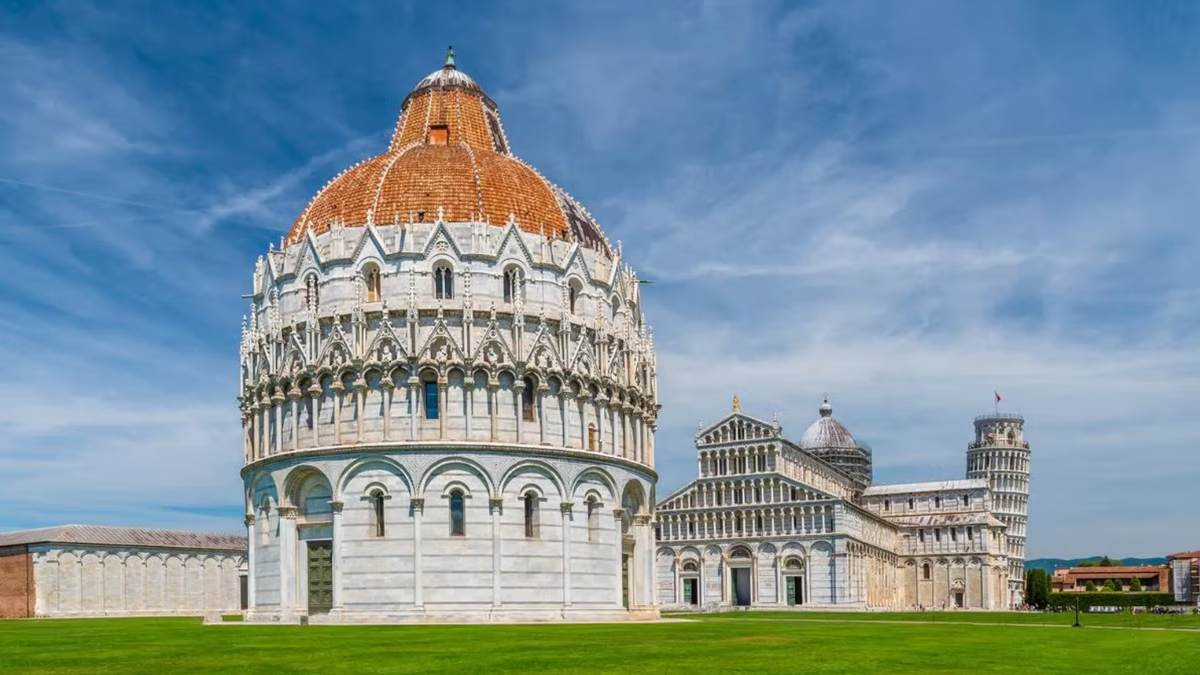
The Pisa Baptistery is the largest baptistery in Italy, standing 54 metres tall and 107 metres in circumference. Entry costs €8 or is included in the full combo ticket. The highlight of any visit is the acoustics demonstration — a staff member sings a few notes that spiral into a full harmonic chord filling the entire dome, an experience almost every visitor describes as the unexpected highlight of their time at Piazza dei Miracoli. Allow 30–45 minutes.
The Baptistery of St. John stands directly opposite the Cathedral’s west facade, its round form a deliberate architectural counterpoint to the Cathedral’s rectangular cross. Most visitors walk past it on their way to photograph the Leaning Tower without a second thought. This is a serious mistake. The Pisa Baptistery is arguably the most surprising building in the square — its austere interior conceals extraordinary acoustics, a sculptural pulpit that prefigured the Renaissance by two centuries, and a history that spans over 200 years of construction by some of medieval Italy’s greatest architects.
History and Construction
Construction began in August 1152 under architect Diotisalvi and was completed in 1363 — over 200 years. The lower storey is Romanesque (Diotisalvi’s original work); the upper levels are Gothic (added by Nicola and Giovanni Pisano in the 13th century). This dual character is clearly visible from the exterior.
The beginning: 1152 Construction of the Baptistery began in August 1152 — six years before the tower and nearly a century after the Cathedral. The foundational inscription inside records the date precisely: 1153 Mense August fundata fuit haec (“In the month of August 1153 was set up here…”). The architect was Diotisalvi, whose name appears inscribed on a pillar inside the building — the same architect now believed by many scholars to have designed the original Tower. Diotisalvi also designed the Church of the Holy Sepulchre in Pisa, and the structural and stylistic similarities between these buildings are clear.
The Baptistery was designed at the same scale as the Cathedral’s west facade — its diameter of approximately 34 metres matches the Cathedral’s facade width exactly. This was not coincidental: the two buildings were designed as a complementary pair, with the round baptistery providing a formal counterpoint to the rectangular cathedral.
The Pisano transformation: 13th century Construction continued for over two centuries, which is why the Baptistery presents two entirely different architectural characters. The lower storey — Diotisalvi’s original work — is Romanesque in character: clean, elegant blind arcading with simple pilasters. The upper levels, added primarily in the 13th century under the direction of Nicola Pisano and later his son Giovanni, are Gothic: pointed arches, elaborate pinnacles, complex decorative carving, and a ribbed dome added over Diotisalvi’s original conical roof.
This dual character — Romanesque base, Gothic top — is clearly readable from the outside. Rather than creating an architectural conflict, it gives the building a layered quality that reflects the genuine passage of time and the evolution of taste during its extended construction.
The original exterior sculptures by the Pisano workshop — including the celebrated “Dancer” (Ballerina) figure and a series of prophets — have been removed for conservation and are now displayed in the Opera del Duomo Museum. The exterior niches visible today are either empty or hold reproductions.
Construction was finally completed in 1363, over 200 years after the foundations were laid.
Architecture
The exterior presents the complete sequence of Pisan architectural history from the mid-12th to the mid-14th century. Ground-floor blind arcades in pure Romanesque form give way to an upper storey of Gothic arches and decorative pinnacles. The dome is ribbed in the Gothic manner. The entrance portal on the west side faces the Cathedral.
The building leans — slightly and almost imperceptibly — approximately 0.6 degrees toward the Cathedral. The same soft Pisan soil that caused the Tower’s famous lean affects the Baptistery, though nowhere near to the same degree.
The interior is deliberately restrained. The whitewashed walls and relatively spare decorative programme create a calm, contemplative space that contrasts strongly with the decorated interior of the Cathedral next door. This austerity is architecturally intentional — the baptistery is a place of initiation, of beginning, and its simplicity reflects a theological programme of clarity and light.
A single circular space with a diameter of approximately 34 metres is enclosed by the outer walls. The floor retains much of its original medieval marble paving. Light enters from a circular oculus in the dome and from the windows of the upper gallery. In the centre of the floor stands the octagonal baptismal font by Guido Bigarelli (1246).
Nicola Pisano’s Pulpit (1260)
Nicola Pisano’s hexagonal pulpit (1260) is considered the first major reassertion of classical sculptural values in medieval Italy — a direct precursor to the Renaissance. Its five relief panels depicting the life of Christ show solid, humanly expressive figures unlike anything else produced in mid-13th-century Europe.
The Baptistery’s artistic centrepiece is Nicola Pisano’s carved hexagonal pulpit, completed in 1260. It is supported by six columns — three resting on the backs of lions, three on plain bases — and a central figure. Five narrative relief panels wrap around the parapet depicting: the Annunciation and Nativity, the Adoration of the Magi, the Presentation at the Temple, the Crucifixion, and the Last Judgement.
Why this pulpit matters so much: Nicola Pisano’s figures are unlike anything produced in Italy in the mid-13th century. They are physically solid, classically proportioned, and humanly expressive in a way that breaks completely with the elongated, abstracted Byzantine figures that dominated religious sculpture before him. His models were the ancient Roman sarcophagi that still existed in Pisa’s Camposanto — he studied and learned from classical sculpture rather than from Byzantine convention.
The pulpit is widely considered a pivotal moment in the history of Western art: the first convincing reassertion of classical sculptural values after centuries of Byzantine stylisation, and a direct precursor to the Renaissance that would emerge in Florence a century and a half later.
Forty years after completing this pulpit, Nicola’s son Giovanni Pisano created the Cathedral’s pulpit (1302–1310) — using his father’s work as the direct model, but producing something more dynamic, more emotionally intense, and stylistically more complex. Visiting both in sequence — Baptistery, then Cathedral — allows a direct comparison between two of medieval Italy’s greatest sculptures.
The Acoustics: The Unforgettable Experience
The Baptistery’s double-shelled dome creates extraordinary natural resonance. A single sung note sustains for 8–10 seconds and divides into harmonic overtones filling the entire building. Staff members perform this demonstration several times per hour. It is the single most-described highlight of Piazza dei Miracoli — and entirely inimitable in any virtual format.
The Baptistery’s double-shelled dome creates one of the most remarkable acoustic environments in any building in the world. The outer dome and the inner dome are separated by an air gap; sound entering this cavity resonates and amplifies before returning to the interior in layered harmonic waves.
The practical result: a single sung note sustains, amplifies, and divides into overtones that fill the entire building as a chord. The effect has been measured: a single note can sustain for approximately 8–10 seconds after the sound source stops. Multiple notes sung in sequence create overlapping harmonics that persist simultaneously — a single voice producing the effect of a choir.
The demonstration is performed by staff members several times per hour throughout the day. A guard steps to the centre of the space, sings a series of notes into the dome, and the building responds. Visitors from every acoustic background consistently describe the experience as the unexpected highlight of their entire visit to Piazza dei Miracoli. Children in particular respond strongly — the surprise and wonder of hearing a building sing is visceral and immediate.
The demonstration has no equivalent anywhere in the square. The Tower climb is memorable, the Cathedral pulpit is significant, but the Baptistery acoustics demonstration is uniquely experiential — it cannot be photographed, described, or replicated. It must be heard.
Galileo Galilei was baptised in this building in February 1565 — six weeks after his birth in Pisa.
Visiting Practical Information
Entry €8 standalone (Cathedral included); €27 full combo. Opens approximately 9:00 AM, closes 5:00–7:00 PM depending on season. Some areas may be temporarily closed for restoration. Allow 30–45 minutes including the acoustics demonstration.
Ticket: €8 standalone (includes automatic Cathedral entry); €27 full combo (all six monuments); €15 monuments-only combo (all except Tower).
Opening hours: Approximately 9:00 AM to 7:00 PM in summer; 9:00 AM to 5:00–6:00 PM in winter. Check opapisa.it for current hours. Note: some areas of the Baptistery may be temporarily closed due to ongoing restoration work on the matroneum gallery. Check before visiting if this is important to your plans.
Dress code: Modest dress required — shoulders and knees covered.
Photography: Permitted inside.
Time needed: 30–45 minutes, including waiting for and experiencing the acoustics demonstration.
When to visit: Any time of day. The acoustics demonstration happens regardless of how many visitors are present. If the building is very full, the demonstration is more powerful — more surfaces absorb and reflect the sound simultaneously.
Buy This TicketFrequently Asked Questions
What is special about the Pisa Baptistery?
Its extraordinary acoustics are the defining feature. The double-shelled dome creates resonance that amplifies a single sung note into a sustained chord that fills the entire building. Staff perform demonstrations several times per hour. Nicola Pisano’s carved pulpit (1260) is also one of the most historically significant sculptures in Western art.
How much does it cost to enter the Baptistery?
€8 standalone (Cathedral entry included). Included in the €27 full combo ticket. Not included in the basic Tower + Cathedral ticket (€20).
How long does the acoustics demonstration last?
Typically 1–2 minutes. Staff members sing a series of notes to demonstrate the harmonics of the dome. The demonstration is informal — staff simply step into the centre of the space and begin singing — rather than a scheduled performance.
Is the Baptistery worth the extra €8 over the basic Tower ticket?
Yes, unreservedly. The acoustics demonstration alone justifies the entrance fee, and Nicola Pisano’s pulpit is a world-class work of art. The Baptistery is consistently described by visitors as a more emotionally affecting experience than the Tower climb.
When was the Pisa Baptistery built?
Construction began in 1152 and was completed in 1363 — over 200 years of construction involving multiple architects. Diotisalvi designed the original Romanesque lower storey; Nicola and Giovanni Pisano directed the Gothic upper levels in the 13th century.
Is the Pisa Baptistery the largest in the world?
It is the largest in Italy and often cited as the largest in the world, though this depends on the definition applied. At 54 metres tall and approximately 34 metres in diameter, it is among the largest free-standing baptismal buildings ever constructed.
