
Piazza dei Miracoli: All the Monuments Explained
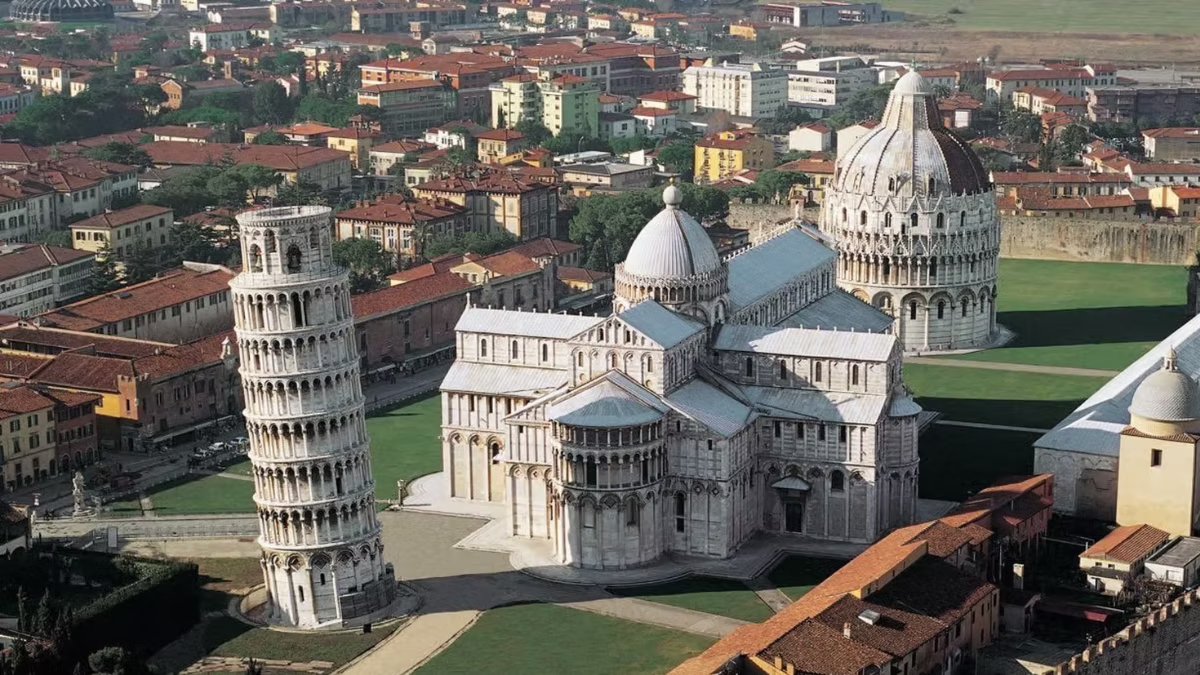
Piazza dei Miracoli (formally Piazza del Duomo) contains six monuments and museums: the Leaning Tower, the Cathedral of Santa Maria Assunta, the Baptistery of St. John, the Camposanto Monumentale, the Opera del Duomo Museum, and the Sinopie Museum. The square is a UNESCO World Heritage Site and one of the most significant architectural ensembles in Europe. Entry to the square itself is free; individual monuments require tickets ranging from €5 to €20, with a full combo at €27.
The name “Piazza dei Miracoli” — Square of Miracles — was coined by the Italian poet Gabriele D’Annunzio in his 1910 novel, who described the site as a “prato dei Miracoli” for the miraculous beauty of its monuments. It has stuck. The square contains four architectural masterpieces built over three centuries during the height of Pisa’s power as a maritime republic, alongside two museums that house the treasures removed from those buildings for conservation. This guide covers each monument in detail: what it is, why it matters, what to look for inside, and how much time to allow.
The Square: An Overview
Piazza dei Miracoli covers 8.87 hectares along the north-western edge of Pisa’s historic centre, just inside the medieval city walls. The position seems counterintuitive — not in the centre of the city, but at its periphery — which was intentional: the complex was built outside the original walls to signal ambition and openness, deliberately positioning Pisa’s greatest monuments as visible to approaching visitors.
The square is oriented on an east-west axis, with the Cathedral at the centre, the Baptistery to its west, the Leaning Tower to its east (behind the Cathedral), and the Camposanto along the north wall. The two museums occupy the south edge near the main entrance gates. The entire complex is enclosed by a low medieval wall with several entrance gates.
The monuments were built to symbolise the three stages of human life according to medieval Christian tradition: the Baptistery for birth, the Cathedral for life, and the Camposanto for death. The Leaning Tower was conceived as the Cathedral’s bell tower — architecturally part of the Cathedral complex rather than a separate monument.
UNESCO inscription: Piazza del Duomo, Pisa was listed as a UNESCO World Heritage Site in 1987, recognised for its exceptional universal value as a concentrated example of medieval Christian architecture and as a place directly associated with Galileo Galilei’s formative scientific work.
Monument 1: The Cathedral of Santa Maria Assunta
The Cathedral is free to enter (free pass required from the ticket office). It opens at 10:00 AM. Allow 45–60 minutes. The highlight is Giovanni Pisano’s carved pulpit (1302–1310) — one of the masterpieces of medieval European sculpture. Modest dress required.
Built: 1064–1092 (with later enlargements through the 14th century) Architect: Buscheto; later work by Rainaldo Ticket: Free (requires a free pass from the ticket office, included with any paid ticket) Time needed: 45–60 minutes
The Cathedral is the oldest and most significant building in the complex. Construction began in 1064, funded by the spoils of Pisa’s naval victory over the Arabs at Palermo — a direct expression of the city’s military and commercial power. The architect Buscheto created what would become one of the defining examples of Pisan Romanesque architecture: a style that blended classical, Byzantine, Lombard, and Islamic influences into something entirely new.
The exterior is extraordinary: alternating bands of white and grey marble, four tiers of blind arcading on the upper facade, interlocking colonnaded galleries, and a collection of decorative details that rewards close examination — lozenges, carved capitals, a bronze Islamic griffin on the roof (probably war booty), and three bronze doors by Bonanno Pisano (1180) depicting scenes from the life of Christ. The Cathedral was the largest in Europe for nearly a century after its completion.
The interior opens into a vast five-nave space with a powerful spatial rhythm: long rows of monolithic granite columns from the Isle of Elba support round arches with alternating black and white marble striping. The effect — with pointed arches and an elliptical dome above the crossing — draws on Islamic and Byzantine sources, reflecting the breadth of Pisa’s Mediterranean trade network.
What to look for inside:
- Giovanni Pisano’s pulpit (1302–1310) — The artistic highlight of the Cathedral and one of the masterpieces of medieval sculpture. With approximately 400 carved figures across nine narrative panels depicting the life of Christ, it is more complex than any previous pulpit. The slightly curved side panels were an innovation without precedent. It was dismantled in 1599 and only reassembled (imperfectly) in 1926.
- The Christ in Majesty mosaic in the apse — a Byzantine masterpiece. The figure of St. John the Evangelist was added by Cimabue around 1302.
- Galileo’s Lamp — The large bronze lamp hanging at the nave crossing is known as Galileo’s Lamp, where legend says the young Galileo (then a student in Pisa) observed a chandelier swinging during mass and formulated his theory of the isochronism of the pendulum. The lamp visible today was made after Galileo published his theory; the original, smaller lamp is in the Camposanto.
- The relics of San Ranieri — The patron saint of Pisa, whose mummified remains lie in a glass-sided tomb in the chapel to the left of the main altar. His face was reconstructed following DNA analysis; the silver mask represents him closely.
- The Devil’s Scratches — On the north exterior wall at eye level, a series of small black marks on Roman marble. Legend holds these were left by the devil attempting to stop the Cathedral’s construction.
For a full detailed guide, see The Pisa Cathedral (Duomo): A Complete Guide.
Monument 2: The Baptistery of St. John
Entry €8. Allow 30–45 minutes. The acoustics demonstration — where a staff member sings notes that spiral into a sustained harmonic chord filling the entire dome — is the experience most visitors describe as the unexpected highlight of the entire square. Do not miss it.
Built: 1152–1363 Architect: Diotisalvi; later work by Nicola and Giovanni Pisano Ticket: €8 (or included in combo) Time needed: 30–45 minutes
The Baptistery stands directly opposite the Cathedral’s west facade — its circular plan deliberately aligned with the Cathedral’s width. At 54 metres tall and 107 metres in circumference, it is the largest baptistery in Italy and one of the largest in the world. Construction began in 1152 under Diotisalvi (the same architect likely responsible for the Tower’s original design) and continued for over two centuries, which is why the building presents two distinct architectural characters: Romanesque on the lower storey, Gothic on the upper levels — the transition occurring as Gothic taste arrived in Pisa during the later construction phases, largely through the influence of Nicola and Giovanni Pisano.
The exterior combines the elegance of Romanesque blind arcading at the base with elaborately Gothic pointed arches and decorative pinnacles above. The original exterior sculptures by Nicola and Giovanni Pisano — including the famous “Dancer” (Ballerina) figure — have been removed for conservation and are displayed in the Opera del Duomo Museum.
The interior is spare and whitewashed — a deliberate architectural contrast to the highly decorated Cathedral across the lawn. The baptismal font by Guido Bigarelli occupies the centre of the circular space, lit by natural light from a circular oculus.
Nicola Pisano’s pulpit (1260) is the Baptistery’s artistic centrepiece and one of the foundational works of Italian sculpture. Five narrative panels depicting scenes from the life of Christ show a dramatic departure from the abstracted Byzantine figures of the preceding tradition — Nicola’s figures are solid, classical, and physically present in a way that anticipates the Renaissance by nearly 200 years. Giovanni Pisano later used his father’s pulpit as the direct model for his own in the Cathedral, producing a more dynamic, emotionally complex version.
The acoustics demonstration is the experience that almost every visitor describes as the unexpected highlight of the square. The Baptistery’s double-shelled dome creates extraordinary natural resonance: a single sung note sustains and amplifies into a full harmonic chord that fills the entire building. Staff members perform this demonstration several times per hour. No audio recording or description adequately conveys it — it must be heard in person.
For a full detailed guide, see The Pisa Baptistery: History & What to Expect.
Monument 3: The Leaning Tower of Pisa
Built: 1173–1372 Ticket: €20 (includes Cathedral; or included in combo) Time needed: 30 minutes (timed slot)
The Tower is the campanile (bell tower) of the Cathedral — architecturally part of the Cathedral complex, though universally known as an independent monument. For the full history of its construction, the lean, and the modern stabilisation project, see The History of the Leaning Tower of Pisa and Why Does the Leaning Tower of Pisa Lean?.
For what you see on the climb — the staircase, the hollow core, the bells, and the view from the top — see Inside the Leaning Tower: What You See on the Climb.
Buy This TicketMonument 4: Camposanto Monumentale
Entry €8. Allow 20–30 minutes. The Gothic cloister contains Roman sarcophagi and the remnants of 14th-century frescoes, most of which were destroyed by Allied bombing in 1944. The Triumph of Death by Buonamico Buffalmacco (c.1340) is one of the most important surviving medieval paintings in Europe.
Built: 1278–1464 Architect: Giovanni di Simone Ticket: €8 (or included in combo) Time needed: 20–30 minutes
The Camposanto (“Holy Field”) is Pisa’s ancient monumental cemetery, occupying the entire north side of the square. Construction began in 1278 under Giovanni di Simone — the same architect who directed the Tower’s second construction phase. According to tradition, the building was constructed around a trove of soil brought from Calvary (Golgotha) in Jerusalem by Archbishop Ubaldo de’ Lanfranchi during the Third Crusade, so that Pisa’s most prominent citizens could be buried in holy ground. Whether this tradition is historically accurate is debated, but the name “Campo Santo” — Holy Field — derives directly from it. The word camposanto has since become the standard Italian word for cemetery.
The building is a vast Gothic cloister of extraordinary elegance: 43 blind arches of white marble running around all four sides of a central lawn, creating an atmosphere of profound stillness quite unlike anywhere else in the complex. The cloister contains Roman sarcophagi that were repurposed as Christian tombs, the burial markers of illustrious Pisan citizens from the medieval period onward, and the remnants of extraordinary 14th-century fresco cycles.
The frescoes — which once covered the entire interior wall surface — were severely damaged on 27 July 1944 when Allied incendiary bombs set the lead roof on fire and covered the paintings in molten metal. The most remarkable surviving fragment is The Triumph of Death by Buonamico Buffalmacco (c.1350), a hauntingly powerful depiction of Death on horseback selecting victims — considered one of the most important medieval paintings in Europe. Restoration has been ongoing since 1945.
For a full detailed guide, see Camposanto Monumentale: Pisa's Ancient Cemetery.
Monument 5: Opera del Duomo Museum
Ticket: €8 (or included in combo) Time needed: 30–45 minutes
The Opera del Duomo Museum — housed in the former canons’ residence on the south-east side of the square — holds the original sculptures and treasures removed from the Cathedral and Baptistery facades for conservation. It provides the essential context for understanding what you see on the monument exteriors, since the figures visible there today are primarily reproductions or empty niches.
Highlights of the collection:
- Giovanni Pisano’s prophet and sibyl sculptures from the Baptistery exterior — including the dynamic “Dancer” (Ballerina) figure and figures of prophets with extraordinary emotional expressiveness, positioned originally on the Baptistery’s upper arcade at eye level for the first time
- The “Ivory Madonna and Child” by Giovanni Pisano — considered one of the finest ivory sculptures in existence
- The bronze griffin of Islamic manufacture — probably a war trophy, which sat on the Cathedral roof for centuries
- Views of the Leaning Tower — upper floors of the museum offer elevated views of the Tower from an unusual angle
Monument 6: Sinopie Museum
Ticket: €5 (or included in combo) Time needed: 20–30 minutes
The Sinopie Museum occupies the former Spedale Nuovo (New Hospital) on the south side of the square near the main entrance. It houses the sinopie — the large-scale preparatory drawings in reddish-brown earth pigment that 14th-century fresco painters applied to the plaster beneath their final frescoes.
These drawings were invisible for centuries beneath the painted surfaces. When the 1944 bombing damaged the Camposanto’s upper plaster layer and conservators began the delicate work of removing the surviving frescoes to safety, they discovered these preparatory sketches beneath. The sinopie represent a unique window into the creative process of medieval painters — the thinking, the revisions, the compositional decisions made before the final colour was applied. Works by Buonamico Buffalmacco, Benozzo Gozzoli, Francesco di Traino, and Piero di Puccio are all represented.
Frequently Asked Questions
What does “Piazza dei Miracoli” mean?
“Square of Miracles.” The name was coined by the Italian poet Gabriele D’Annunzio in 1910 and has become universal, though the formal name remains Piazza del Duomo (Cathedral Square).
Is the square free to enter?
Yes. There is no charge to enter Piazza dei Miracoli. The square is a public space. Tickets are only required to enter the individual monuments and museums.
How many monuments are there in Piazza dei Miracoli?
Six: the Leaning Tower, the Cathedral, the Baptistery, the Camposanto, the Opera del Duomo Museum, and the Sinopie Museum.
When was Piazza dei Miracoli listed as a UNESCO World Heritage Site?
In 1987, under the official name “Piazza del Duomo, Pisa.”
What is the symbolism of the three main monuments?
According to medieval Christian tradition, the Baptistery represents birth, the Cathedral represents life, and the Camposanto represents death — the three stages of human existence.
How long does it take to visit everything?
For the Tower, Cathedral, Baptistery, and Camposanto: approximately 3.5–4 hours. For all six monuments including the museums: a full day of 5–6 hours. See our how long to spend guide.
