
Leaning Tower of Pisa Underground: Foundations, Soil & the Lean
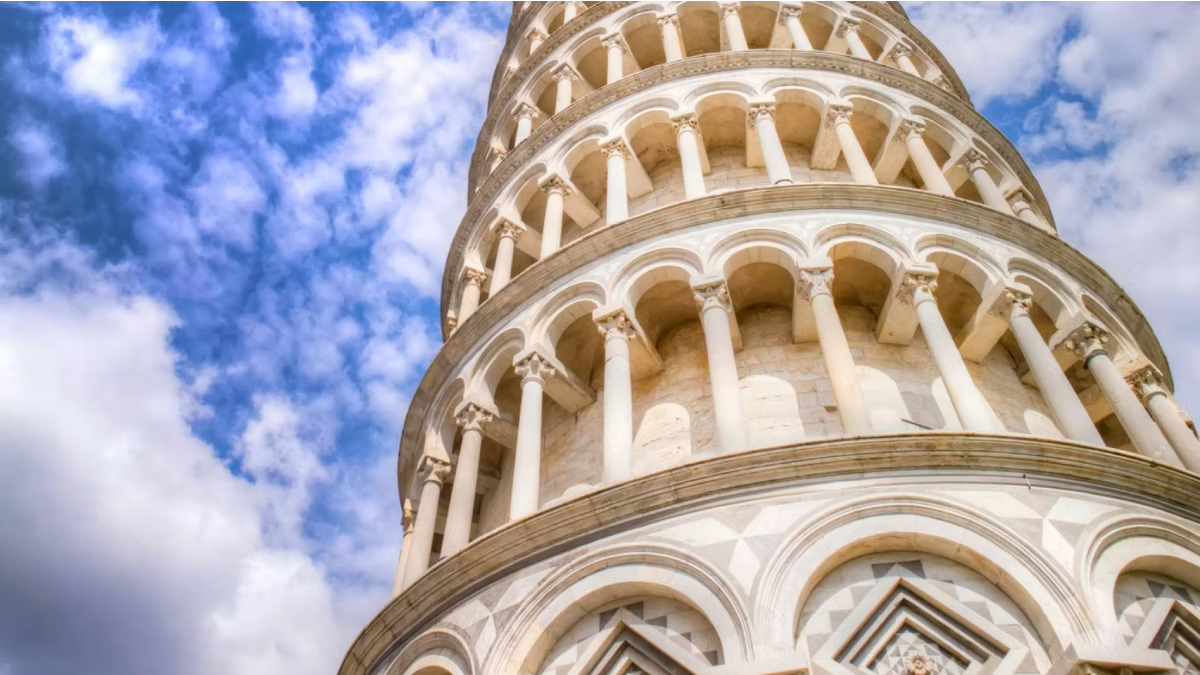
The Leaning Tower of Pisa sits on a circular ring foundation only 3 metres deep — inadequate for a 14,500-tonne structure. Beneath the foundation, soft marine clay in the middle soil horizon (10–40 metres deep) compressed unevenly under the Tower’s weight, causing the southward tilt. Engineers stabilised the Tower between 1993 and 2001 by extracting approximately 38 cubic metres of clay from beneath the north side of the foundation, allowing the Tower to settle back toward vertical and reducing the lean from 5.5 to 3.97 degrees.
Most visitors to Piazza dei Miracoli look upward at the Leaning Tower. Few consider what lies beneath it. But the full story of why the Tower leans — and why it has not fallen — is written in the geology underground as much as in the architecture above. This article goes beneath the surface, explaining the soil profile under the Tower, the geotechnical reasons for the failure, the danger it reached in the 20th century, and the engineering solution that involved removing soil one bucketful at a time.
The City on Soft Ground
Pisa sits on the coastal plain of the Arno River valley, near where the river once entered the Ligurian Sea before centuries of sediment deposition moved the coastline westward. The city’s foundations — like those of all its buildings — rest on alluvial and marine sediments deposited over thousands of years. The name Pisa is thought to derive from the ancient Greek word for marshy land, suggesting awareness of the soft ground went back to antiquity.
This soft ground is not uniformly distributed. Across any given site, the soil composition varies laterally — meaning the ground beneath one side of a building may be meaningfully different from the ground beneath the other. This lateral variability, invisible from the surface, is what caused the Tower to lean.
The Three Soil Horizons
Horizon A (0–10m): sandy/silty alluvial deposits — the layer the foundation sits in. Horizon B (10–40m): soft, saturated Pancone clays — the critical layer whose asymmetric compressibility caused the lean. Horizon C (40–60m): dense sand and gravel — stable, but far below the Tower’s 3-metre-deep foundation.
Geotechnical surveys conducted during the modern stabilisation project mapped the soil profile beneath the Tower in detail. Three distinct horizons were identified:
Horizon A (0–10 metres depth) The uppermost layer is a chaotic mix of alluvial and estuarine deposits: silt, clay, and sand with limited lateral persistence — meaning the composition changes unpredictably even within short horizontal distances. This layer includes material from the ancient harbour that once existed near this site. It was through this layer that the Tower’s 3-metre-deep circular ring foundation was laid.
Horizon B (10–40 metres depth) The critical layer for the Tower’s behaviour. This horizon consists of soft, sensitive marine clays — the “Pancone clays” identified in engineering studies — subdivided into four distinct sub-layers. These clays are: – Saturated with groundwater – Highly compressible under sustained load – Sensitive to disturbance (losing strength rapidly when disturbed) – Variable in thickness and stiffness across the Tower’s footprint
The southern side of the Tower’s foundation sits above slightly thicker and softer clay than the northern side. This asymmetry — invisible in 1173 and only identifiable with modern borehole testing — is the direct cause of the lean. As the Tower grew heavier, the south side compressed faster than the north.
Horizon C (40–60 metres depth) Dense sand and gravel — stable and strong. Had the Tower’s foundations reached this layer, there would have been no lean. But at 3 metres deep, the foundations stopped far above it, in the least reliable part of the soil profile.
The Foundation Itself
A circular ring foundation, 3 metres deep and approximately 19.6 metres in outer diameter. Standard 12th-century construction practice, but critically inadequate for a 14,500-tonne structure on soft alluvial soil. The inadequate depth is the root cause of the lean.
The Tower was built on a circular ring foundation — essentially a hollow cylinder of masonry at the base, not a solid raft. The outer diameter of this foundation ring is approximately 19.6 metres; the ring width is approximately 7.7 metres. The foundation depth of 3 metres was standard practice for 12th-century Italian construction. There was no systematic method in 1173 for testing soil bearing capacity or predicting long-term settlement under sustained load.
The total load delivered to the foundation by the completed Tower is approximately 14,500 tonnes — the weight of the marble, mortar, and internal staircase and walls of the structure. Distributed over the foundation ring area, this generates significant pressure on the underlying soil — far more than the soft Horizon A and upper Horizon B deposits could support without deforming.
The Mechanism of Differential Settlement
The south side of the foundation sits above slightly softer and thicker Pancone clay than the north side. Under the Tower’s growing weight, the south side compressed faster, creating a tilt that became visible by the third floor in 1178. The 94-year construction pause that followed allowed the clay to consolidate — inadvertently saving the Tower.
The lean is caused by differential settlement — the phenomenon where one side of a foundation sinks more than the other. In the Tower’s case, the process worked as follows:
- Construction begins (1173): The foundation is laid in Horizon A deposits. Early construction progresses without visible problems.
- Weight accumulates (1173–1178): As the tower grows from one storey to three, the load on the foundation increases substantially. The soft Horizon B clays below begin to compress.
- Differential compression appears (1178): The south side of the foundation, sitting above slightly softer and more compressible clay, sinks faster than the north side. The difference is small at this stage — millimetres — but enough to tilt the partially completed tower visibly.
- Construction halts (1178): The lean is noticed and construction stops.
- Soil consolidation during the pause (1178–1272): During the 94-year construction pause forced by wars, the clay beneath the foundation continues to consolidate under the weight of the partially completed Tower. The water in the clay pores is slowly squeezed out; the clay becomes denser and stronger. This consolidation is what allowed construction to resume safely — the ground had time to adapt to the load.
- Construction resumes and continues (1272–1372): The Tower grows taller, the load increases, and differential settlement continues — but at a slower rate because the clay has been partially consolidated.
- Post-completion creep (1372–1990): Over six centuries, the lean increases slowly but measurably — approximately 1–1.2 millimetres per year through the 20th century.
The Groundwater Factor
The Pisan water table is high — typically 1–2 metres below the surface. The Pancone clays in Horizon B are fully saturated. When load is applied to saturated clay, the water in the pore spaces carries the initial stress. Over time, as water drains from the pores (a slow process in clay), the soil skeleton compresses and the surface settles. This time-dependent process is called consolidation, and it explains why the Tower’s lean developed slowly over centuries rather than catastrophically during construction.
The high water table also means that any excavation around the Tower’s foundation carries serious risk of destabilising the equilibrium. This was the core engineering challenge in 1990: how to intervene in the foundation system without triggering sudden movement.
The 1990 Crisis
By 1990, the lean had reached 5.5 degrees. The Tower was tilting at approximately 1–1.2 millimetres per year and engineers calculated it was approaching the point of leaning instability — where the centre of gravity would pass outside the base area, causing toppling. The collapse of the Civic Tower of Pavia in 1989 — a medieval masonry structure that failed without warning, killing four people — prompted urgent action. Italy closed the Tower and assembled an international committee of engineers, art historians, and conservation specialists.
The committee faced a constraint that made the problem uniquely difficult: the Tower’s lean was the reason millions of people visited Pisa. Any intervention that eliminated the lean would destroy the monument’s identity. The goal was to reduce the lean to a safe level while preserving the character of the tilt.
The Soil Extraction Solution (1993–2001)
41 extraction holes were drilled beneath the north (high) side of the foundation. Clay was removed in quantities of 100–150 kg at a time — 38 cubic metres total — allowing the north side to settle and the Tower to rotate back toward vertical. The lean reduced from 5.5 to 3.97 degrees between 1999 and 2001.
After considering numerous approaches — including foundation reinforcement, soil injection, and external propping — the committee selected underexcavation: the controlled removal of small volumes of soil from beneath the high (north) side of the foundation.
The logic was straightforward in principle: if the south side sinks faster than the north because the south-side soil is softer, then removing soil from the north side allows the north side to settle slightly, pulling the Tower back toward vertical.
The execution was extraordinarily delicate:
Phase 1 — Lead counterweights (1993–1995): 870 tonnes of lead ingots were placed on the north side of the Tower’s base as temporary counterweights, slightly tilting the structure back toward vertical and relieving the critical lean-direction stress. This was a controlled load management intervention, not the final solution.
Phase 2 — Steel cable stabilisation: Steel cables were wrapped around the Tower’s third storey and anchored hundreds of metres away to the north, providing a safety harness during the most delicate extraction phases.
Phase 3 — Soil extraction (1999–2001): 41 extraction holes were drilled at a slight angle beneath the north side of the foundation. Small soil extraction augers removed clay in quantities of 100–150 kg at a time — approximately 38 cubic metres total. Engineers monitored the Tower’s tilt continuously, adjusting extraction rates to maintain a controlled and gradual recovery.
The Tower responded as predicted. The north side settled slightly, the Tower rotated back toward vertical, and the lean reduced from 5.5 degrees to 3.97 degrees — returning it to approximately the position it occupied in 1838. The lead counterweights were removed; the steel cables were released; the Tower was stable.
The project was declared complete in 2001. The Tower reopened to the public in December of that year, after 11 years of closure.
What Happens Underground Now
Engineers continue to monitor the Tower’s foundation and subsoil behaviour through an array of sensors embedded in the foundation and in the soil at depth. Since the stabilisation, the Tower has been very slowly recovering further — moving back toward vertical at a small fraction per year as the clay beneath the north foundation continues to consolidate following the extraction. By 2013, approximately 2.5 centimetres of additional lean had been recovered naturally since 2001.
The monitoring data is reviewed continuously. Engineers forecast that some future intervention will eventually be needed — the soil and structure will continue to evolve — but that the current stabilisation is effective for at least 200–300 years.
Frequently Asked Questions
How deep are the foundations of the Leaning Tower of Pisa?
Only 3 metres — remarkably shallow for a 14,500-tonne structure. This inadequate depth, combined with the soft marine clay in the soil beneath, is the direct cause of the lean.
What type of soil is the Tower built on?
Alluvial and marine deposits in three horizons: sandy/silty deposits in the upper 10 metres, soft compressible Pancone clays from 10–40 metres depth (the critical layer), and dense sand and gravel below 40 metres. The Tower’s foundations only reach the first layer.
Why did the soil cause the lean?
The clay deposits beneath the south side of the foundation are slightly thicker and more compressible than those beneath the north side. Under the Tower’s weight, the south side compressed faster, causing differential settlement and the characteristic tilt.
How was the Tower stabilised?
By extracting approximately 38 cubic metres of clay from beneath the north (high) side of the foundation between 1999 and 2001. This allowed the north side to settle slightly, pulling the Tower back toward vertical and reducing the lean from 5.5 to 3.97 degrees.
Is the Tower still moving?
Yes — very slowly, and currently in a favourable direction. The Tower has been recovering slightly toward vertical since 2001 as the soil continues to consolidate naturally following the extraction.
Could the Tower fall?
Engineers assess the current risk as very low. The 1993–2001 stabilisation is considered effective for 200–300 years. The Tower is continuously monitored with embedded sensors.
