
Why Does the Leaning Tower of Pisa Lean?
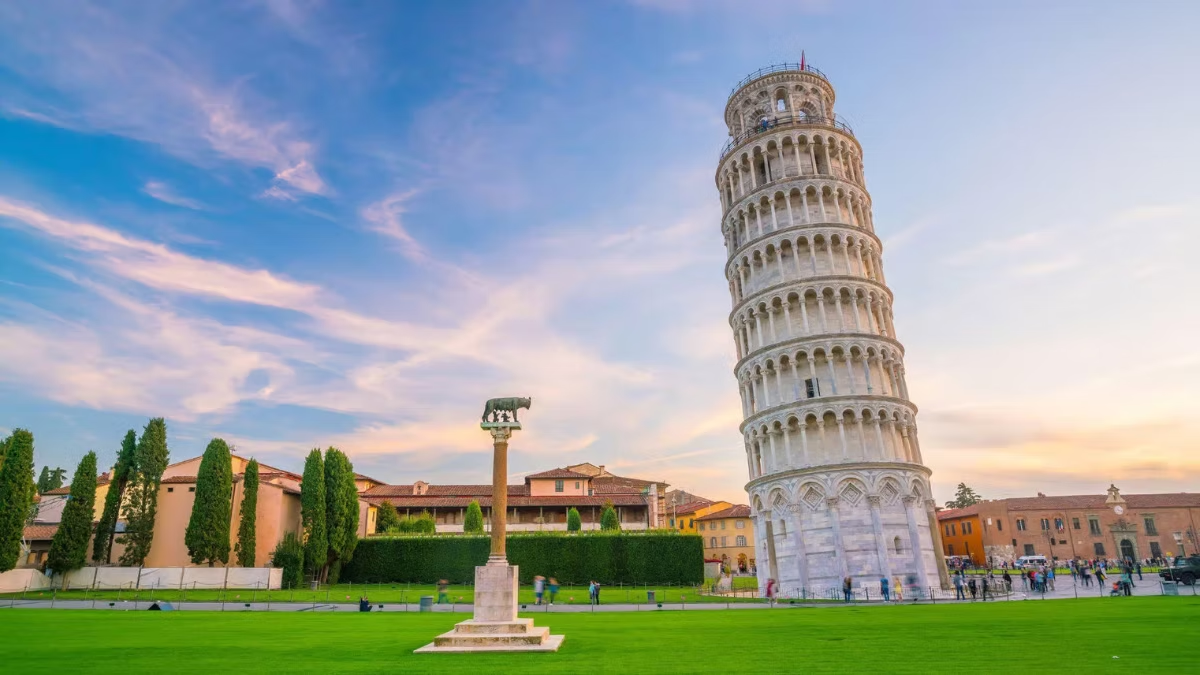
The Leaning Tower of Pisa leans because its foundations were built on soft, unstable soil — a mixture of clay, fine sand, and shells — which could not support the structure’s weight evenly. The south side of the foundation was slightly softer than the north, and as the tower grew heavier with each floor, the south side sank more rapidly, causing the tilt. The lean was unintentional. Construction began in 1173; by 1178 the lean was already visible. The current lean of 3.97 degrees was stabilised between 1993 and 2001 by extracting soil from beneath the high (north) side of the foundation.
No architectural question attracts more curiosity than this one. The Leaning Tower of Pisa is among the most visited landmarks in the world — and what people most want to know is: why is it like this, and how has it not fallen down? This guide gives the complete scientific and historical answer.
The Short Answer: Bad Ground, Shallow Foundations
The Tower was built on soil that was too soft and too shallow a foundation for a structure of its weight. The tower weighs approximately 14,500 tonnes. Its foundations are only 3 metres deep — remarkably shallow for a building of this mass. The soil beneath the southern edge of those foundations was marginally softer than beneath the northern edge. As the tower grew taller and heavier, the south side sank faster, and the tilt began.
This is the fundamental cause. Everything else in the Tower’s story flows from this single engineering decision made in 1173.
The Ground Beneath Pisa
Three soil layers lie beneath the Tower: sandy/silty deposits in the upper 10 metres; soft, saturated Pancone clay from 10–40 metres depth (the critical layer); and dense sand below 40 metres. The Tower’s 3-metre foundation only reaches the first layer — far too shallow for a 14,500-tonne structure.
The city of Pisa itself stands on soft alluvial soil deposited over millennia by the Arno River and the adjacent coastal wetlands. The city’s name is thought to derive from the Greek word for “marshy land” — an indication of how well-understood the local soil conditions were even in antiquity.
Beneath the Tower’s foundations, the soil is layered in three main strata:
Upper layer — fine sandy soil, approximately 10 metres deep. This is relatively stable. Middle layer — soft marine clay, approximately 40 metres deep. This is the critical layer: compressible, saturated with water, and prone to consolidation under sustained load. Lower layer — dense sand and gravel. Stable, but below the zone of influence for the Tower’s foundations.
The soft marine clay in the middle layer is the structural villain of the story. Under the sustained load of 14,500 tonnes, this layer compresses — and compresses unevenly, because its composition varies laterally across the site. The south side of the Tower sits above slightly thicker and softer clay than the north side. That small difference in compressibility caused the differential settlement that produced the lean.
Why Didn’t the Architects Know?
Medieval building technology had no systematic methods for assessing subsurface soil conditions before construction. Foundation depth and design were based on experience and tradition rather than any understanding of soil mechanics as a discipline — that field of civil engineering would not exist for centuries.
Pisa had been built on this same soil for many centuries, and many structures had been erected without visible problems. The Tower’s particular vulnerability arose from two factors that were not obvious in advance: its extreme height (designed to reach 56 metres) relative to the shallow foundation depth, and the specific location within the square where slightly softer subsoil happened to sit beneath the south side of the footprint.
Notably, the Baptistery of St. John in Piazza dei Miracoli also leans — by 0.6 degrees toward the Cathedral. Several other Pisan bell towers lean for the same reason. Pisa’s soft ground is a city-wide condition, not specific to the Tower’s site.
The Moment the Lean Began: 1178
Construction began in 1173. By 1178 — just five years later, after the third floor had been completed — the lean was already visible and measurable. At this point, the uneven soil settlement had already begun to tilt the structure.
Construction halted. Ironically, this pause — forced by wars between Pisa and rival Italian city-states — gave the soil time to consolidate under the weight of the incomplete tower. Engineers studying the structure in the 20th century concluded that without this interruption, the Tower would almost certainly have toppled before it was finished. The soil needed time to compress and stabilise before bearing more load. The wars saved the Tower.
Construction resumed in 1272 after approximately 94 years. By this point, the soil had consolidated sufficiently for the structure to continue growing without immediate risk of collapse. The architect Giovanni di Simone attempted to compensate for the existing lean by building the upper floors with one side slightly taller — essentially introducing a curve to counteract the tilt. This is why the Tower is not a simple leaning cylinder: it has a very slight banana-shaped curvature when examined carefully from certain angles.
Why Doesn’t It Fall Over?
The Tower’s centre of gravity remains within its base area even at 3.97 degrees of lean. Paradoxically, the soft soil that caused the lean also protects it — research shows the soil’s properties create a resonant frequency that doesn’t match regional earthquake motion, protecting the Tower from seismic damage.
This is the question that most surprises visitors. At 3.97 degrees of lean, why is the Tower stable at all?
The weight distribution. The Tower is a hollow cylinder — essentially a thick-walled tube. The centre of gravity of this shape lies within the base of the structure even at the current lean, meaning the Tower is not on the verge of toppling. A structure tips when its centre of gravity passes outside the area of its base; the Leaning Tower has not reached that point.
The soil consolidation. Paradoxically, the same soft soil that caused the lean has also helped prevent collapse. As the Tower leaned and the south side settled, the soil beneath the south foundation compressed and became denser and more load-bearing over time. The increasing resistance of the compressed soil provided a natural brake on further tilting — though this brake was never fully reliable.
Earthquake resistance. In one of engineering’s greatest ironies, the same soft soil that caused the lean also protected the Tower from earthquakes. Research published in 2001 found that the Tower’s height, stiffness, and the characteristics of the soft foundation soil combine to produce a resonant frequency that does not match the frequency of seismic ground motion in the region. The Tower has survived at least four significant regional earthquakes since 1280. Had it been built on hard ground, it might have collapsed in one of them.
What Happened in the 20th Century: The Crisis
By 1990, the lean had reached 5.5 degrees — the most extreme in the Tower’s history. The rate of increase had been approximately 1–1.2 millimetres per year, meaning the lean was growing perceptibly. Engineers warned that if nothing was done, the Tower would become unstable within decades.
Two previous interventions had made things worse: in 1838, excavation around the Tower’s base to expose its carved lower section caused a sudden increase in the lean; in the 1930s, Mussolini’s injection of concrete into the south foundation caused the Tower to lurch further. Both interventions destabilised the foundation rather than strengthening it.
The collapse of the Civic Tower of Pavia in 1989, which killed four people, prompted the Italian government to close the Leaning Tower in 1990 while engineers worked out a solution.
The Solution: Soil Extraction (1993–2001)
Engineers drilled 41 extraction holes beneath the north (high) side of the foundation and removed 38 cubic metres of clay in quantities of 100–150 kg at a time. This allowed the north side to settle slightly, pulling the Tower back toward vertical. The lean reduced from 5.5 to 3.97 degrees between 1999 and 2001.
The engineering team’s solution was deceptively simple in principle: remove soil from beneath the high (north) side of the foundation. By carefully extracting approximately 38 cubic metres of earth from the north side using a sophisticated drilling and extraction system, engineers allowed the Tower to settle slightly northward — reducing the lean from 5.5 to 3.97 degrees.
The operation was extraordinarily delicate. Remove too little soil and the lean would not reduce; remove too much and the Tower could suddenly shift or destabilise. Steel cables wrapped around the third storey, anchored hundreds of metres away, provided temporary stabilisation during the most sensitive phases. Lead counterweights on the north side provided additional control.
The project cost approximately €30 million and took eight years from initiation to completion. The Tower was declared stable and reopened to the public in 2001. Engineers estimated the stabilised structure would remain safe for at least 200–300 years without further major intervention.
Since 2001, monitoring has shown that the Tower is continuing very slowly to recover — moving slightly further back toward vertical as the soil beneath the foundation continues to consolidate naturally. By 2013, approximately 2.5 additional centimetres of lean had been recovered since the stabilisation was completed.
Is the Lean Still Changing?
Yes — very slowly, and currently in a favourable direction. The Tower continues to move imperceptibly back toward vertical as the soil consolidates following the 1993–2001 intervention. Engineers monitor the structure continuously with sensors embedded in the foundations and subsoil. There are no current concerns about stability.
Did Anyone Try to Straighten It Completely?
Yes — and each major attempt made things worse. Gherardesca’s 1838 excavation, Mussolini’s 1930s concrete injection, and various earlier interventions all had negative effects. The 1993–2001 project succeeded partly because the engineers understood that the goal was stabilisation at a safe lean — not vertical alignment. Straightening the Tower would have destroyed both its iconic identity and its structural equilibrium, which has now been adjusted precisely to the current tilt.
Frequently Asked Questions
Why does the Leaning Tower of Pisa lean?
Because its foundations were built on soft, unstable soil that settled unevenly under the tower’s weight. The south side of the foundation sat on slightly softer ground than the north side, causing the south to sink faster and the tower to tilt southward.
Was the lean intentional?
No. The Tower was designed to be straight and vertical. The lean was an unintended consequence of inadequate foundation depth and soft subsoil. The builders attempted — unsuccessfully — to correct it during construction by building upper floors with one side taller than the other.
How far does the Tower lean?
Currently 3.97 degrees, equivalent to approximately 3.9 metres off vertical at the belfry level. Before the 1993–2001 stabilisation, it leaned at 5.5 degrees — approximately 5.5 metres off vertical.
Will the Tower ever fall?
The Tower is considered stable for the next 200–300 years based on current engineering assessments. The 1993–2001 stabilisation project brought the lean back to a safe level, and ongoing monitoring shows no cause for concern. However, engineers acknowledge that some form of intervention will eventually be needed by future generations.
Why didn’t the Tower fall during construction?
The long pauses in construction — caused by medieval wars — gave the soft soil time to compress and consolidate under the weight of the partially built structure. This inadvertent rest strengthened the foundation just enough to allow construction to continue. Without these pauses, the Tower would almost certainly have collapsed before completion.
Does the Baptistery also lean?
Yes. The Baptistery of St. John in Piazza dei Miracoli leans approximately 0.6 degrees toward the Cathedral. Several other medieval towers in Pisa lean for the same reason — the soft alluvial soil is a city-wide condition.
