
Camposanto Monumentale: Pisa's Ancient Cemetery
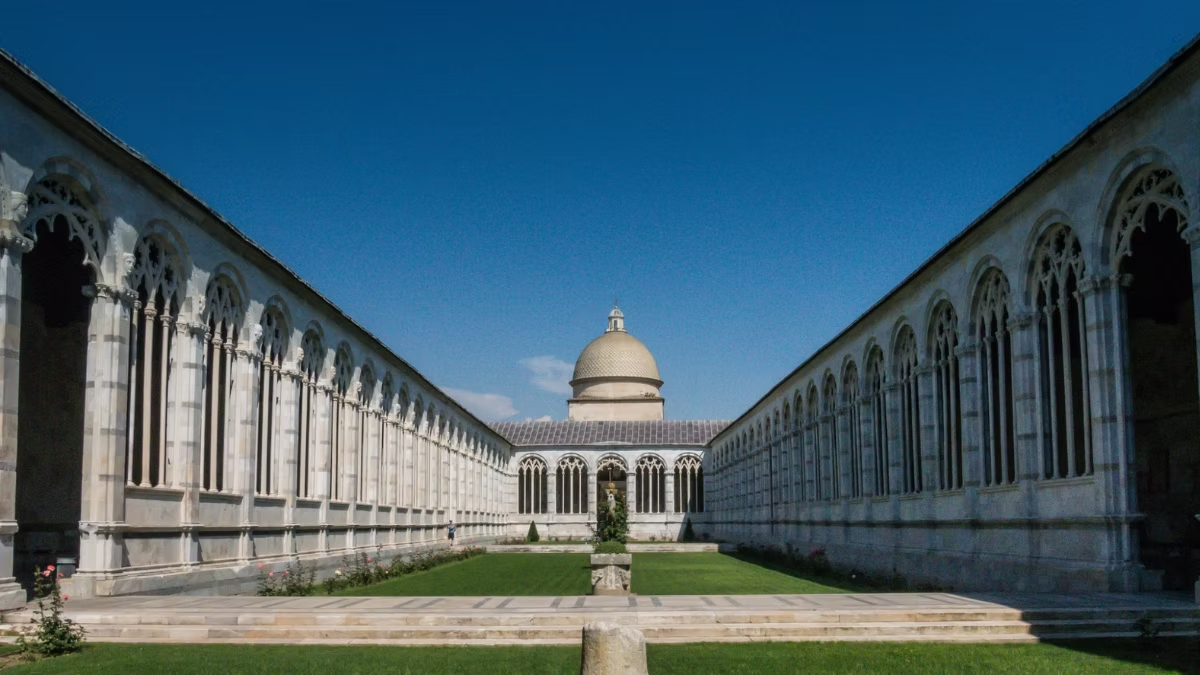
The Camposanto Monumentale is Pisa’s ancient monumental cemetery on the north side of Piazza dei Miracoli. Entry costs €8 or is included in the full combo ticket. The building is a vast Gothic cloister built around soil allegedly brought from Calvary during the Third Crusade. Its walls were once covered in extraordinary 14th-century frescoes, most of which were destroyed in a 1944 Allied bombing; the surviving Triumph of Death by Buonamico Buffalmacco is one of the most important medieval paintings in Europe. Allow 20–30 minutes.
Of all the monuments in Piazza dei Miracoli, the Camposanto is the most overlooked and the most quietly rewarding. While the Leaning Tower draws the crowds and the Cathedral and Baptistery fill with visitors, the Camposanto tends to be entered by fewer people — and those who do enter find the most contemplative and historically layered space in the entire complex. This is a place where medieval Pisa buried its greatest citizens, where extraordinary paintings were nearly lost forever, and where the relationship between art, war, and survival becomes immediately and viscerally legible.
History and Origins
The Camposanto was built around soil allegedly brought from Calvary (Golgotha) during the Third Crusade by Archbishop Ubaldo de’ Lanfranchi of Pisa. Construction of the Gothic cloister began in 1278 under Giovanni di Simone and was completed in 1464. The word “camposanto” (holy field) has since become the standard Italian word for cemetery.
The Holy Field The name Camposanto means “Holy Field” in Italian, and it has become the standard Italian word for cemetery. The origin of the name — and the building’s founding legend — is that Archbishop Ubaldo de’ Lanfranchi of Pisa brought back a shipload of soil from Golgotha (Calvary), the site of the Crucifixion in Jerusalem, during the Third Crusade in the 12th century. This sacred earth was used as the foundation of the cemetery, so that Pisa’s most distinguished citizens could be buried in holy ground. The legend adds that any body buried in this soil would decompose within 24 hours — a miraculous purification.
Whether the Golgotha soil tradition is historically accurate is debated, but it was the stated foundation of the building’s religious identity for centuries and explains why it became the preferred burial ground for Pisa’s nobility, clergy, and civic leaders.
Construction (1278–1464) The building itself was begun in 1278 by the architect Giovanni di Simone — the same master builder who directed the Leaning Tower’s second construction phase and who died in 1284 when Pisa was defeated at the naval Battle of Meloria by the Genoese. Construction continued for nearly two more centuries, with the cloister completed in 1464.
The structure replaces an earlier burial ground that occupied the same site, along with an octagonal baptistery from the Lombard period whose foundations survive beneath the current floor.
Architecture
The Camposanto is a vast rectangular Gothic cloister approximately 150 metres long, occupying the entire north side of Piazza dei Miracoli. 43 blind arches of white Carrara marble run around all four sides of the cloister, their Gothic tracery windows (now glazed) looking out over a central rectangular lawn. Two gateways provide entry — the principal door on the south side, crowned by a Gothic tabernacle with the Virgin Mary with Child surrounded by four saints.
The exterior presents a long, unbroken marble facade to the square — austere, horizontally emphatic, and enormous. From inside, the proportions of the cloister are impressive: the gallery runs the full length and width of the complex, enclosing a space large enough to contain a small garden. The atmosphere is entirely different from the busy square outside — quiet, cool, and contemplative.
Along the inner walls and floor of the cloister are 84 Roman sarcophagi, the survivors of a collection that was once far larger. These ancient marble coffins were repurposed as Christian tombs for Pisan nobles from the medieval period onward — a practice that blended the prestige of Roman antiquity with Christian burial tradition. Many retain their original carved reliefs depicting mythological scenes, battle narratives, and funeral processions.
Additional burial markers cover the floor — grave slabs and inscriptions commemorating Pisan citizens from the medieval period through the 18th century, when Grand Duke Pietro Leopoldo forbade further burials inside the city walls and opened a new cemetery outside.
The harbour chains hang from the walls of the cloister — iron chains that once blocked the harbour of Pisa, seized by the Genoese after their victory at the Battle of Meloria in 1284 and eventually returned to Pisa in 1860 as a gesture of reconciliation. They hang as a memorial to Pisa’s greatest naval defeat and its long aftermath.
The Frescoes and the 1944 Disaster
Allied incendiary bombs struck the Camposanto on 27 July 1944. The lead roof caught fire and molten lead poured over the frescoes, destroying most of the 2,000 square metres of 14th-century painting. During restoration, conservators discovered the sinopie — preparatory drawings hidden beneath the frescoes for six centuries — now displayed in the Sinopie Museum.
Before the Second World War, the inner walls of the Camposanto were covered in approximately 2,000 square metres of medieval and Renaissance frescoes — one of the largest fresco cycles in Italy, painted by the greatest masters of the 14th and 15th centuries. The programme included scenes from the Old Testament, the lives of the saints, the Last Judgement, stories of the Anchorites (desert hermits), and the most famous of all, the Triumph of Death.
On 27 July 1944, Allied incendiary bombs struck the Camposanto. The lead roof caught fire and molten lead poured down over the painted surfaces. The heat and chemical damage was catastrophic. The majority of the frescoes were destroyed or severely damaged. The loss was, by any measure, one of the greatest destructions of medieval art in the 20th century.
In the immediate aftermath, conservators began the painstaking process of detaching surviving fresco fragments from the walls. During this work, they made an extraordinary discovery: beneath the painted surfaces were the sinopie — large preparatory drawings in reddish earth pigment that the 14th-century painters had laid onto the plaster before applying their final colours. These drawings, invisible for six centuries, had been protected by the fresco layer above. The sinopie were carefully removed and are now displayed in the Sinopie Museum on the south side of Piazza dei Miracoli.
Restoration of the Camposanto frescoes has continued since 1945 and is among the most complex conservation projects in post-war Italian art history. The Triumph of Death was fully restored and returned to its original location on the northeast wall in 2018 after decades of work.
The Triumph of Death
Painted by Buonamico Buffalmacco around 1336–1341, this 15-metre-wide fresco depicts Death as a winged figure with a scythe sweeping over a garden party of aristocrats and clergy. Painted in the years surrounding the Black Death epidemic in Pisa, it is one of the most powerful medieval paintings in Europe. Fully restored and returned to the Camposanto in 2018.
The Triumph of Death is the most important surviving fresco in the Camposanto and one of the most significant medieval paintings in Europe. It stretches approximately 15 metres wide and 5.6 metres high on the northeast wall of the cloister.
It was painted around 1336–1341, attributed to Buonamico Buffalmacco — an artist mentioned by Boccaccio in the Decameron as a prankster and wit, but clearly a painter of extraordinary power. Some scholars have alternatively attributed the work to Francesco Traini; the question is not fully resolved.
The fresco consists of three connected scenes:
The Three Living and the Three Dead (left section): Three elegantly dressed noblemen on horseback, out hunting, suddenly encounter three open coffins containing corpses in progressive states of decomposition. One nobleman holds his nose; his horse rears back in disgust. A hermit holds a scroll with a written warning about mortality. The contrast between the living riders’ finery and the decomposing dead is stark and deliberate.
The Triumph of Death (centre): Death — depicted as a terrifying winged figure carrying a scythe — swoops over a garden party of aristocrats and musicians, indifferent to rank or pleasure. Cripples and beggars beg for death to take them quickly; clergy and laypeople alike are seized. Demons and angels struggle in the air for the souls of the recently dead. The painting was created in the years immediately following the Black Death’s arrival in Pisa (1348), when the city had lost a catastrophic proportion of its population. The painting’s emotional charge — its simultaneous horror, dark humour, and theological insistence that death comes for everyone — reflects a society that had just witnessed exactly that.
The Last Judgement and Hell (right section): Christ presides over the weighing of souls; the blessed ascend; the damned descend into a vivid depiction of Hell.
The composer Franz Liszt visited the Camposanto in 1839, was profoundly affected by these frescoes, and composed his Totentanz (“Dance of Death”) in response — one of the most celebrated piano concerto compositions of the 19th century.
What Else to See
The Benozzo Gozzoli frescoes — Stories of the Old Testament by Benozzo Gozzoli (15th century), partially surviving in the north gallery. Gozzoli’s cycle of Old Testament scenes was remarkable for the narrative richness and the skill of the sinopie drawings discovered beneath them — now the centrepiece of the Sinopie Museum.
The Theological Cosmography by Piero di Puccio (late 14th century) — a rare depiction of medieval cosmological theory showing the universe arranged in concentric circles, with Earth at the centre and the celestial spheres surrounding it.
The Fibonacci connection — the medieval mathematician Leonardo Fibonacci (c.1170–1250), whose book Liber Abaci introduced Arabic numerals and the concept of zero to medieval Europe, is buried in the Camposanto. A monument to him stands in the cloister.
The Cappella del Pozzo — a small domed chapel added in 1594, named after Archbishop Carlo Antonio del Pozzo.
Visiting Practical Information
Ticket: €8 standalone (Cathedral entry included); €27 full combo (all six monuments); €15 monuments-only combo (without Tower). Free entry on 1 and 2 November (All Saints’ Day and All Souls’ Day).
Opening hours: Generally 8:00 AM–8:00 PM in peak season; shorter hours in winter. Check opapisa.it for current hours.
Time needed: 20–30 minutes for a standard visit; up to 45 minutes for those who want to examine the frescoes carefully and read the sarcophagi inscriptions.
Dress code: Modest dress required as with all monuments in the complex.
Photography: Permitted throughout.
Buy This TicketFrequently Asked Questions
What is the Camposanto in Pisa?
The Camposanto Monumentale is Pisa’s ancient monumental cemetery on the north side of Piazza dei Miracoli. It is a vast Gothic cloister built from 1278, containing Roman sarcophagi, medieval tomb markers, and the remains of extraordinary 14th-century frescoes.
Why is it called Camposanto?
“Camposanto” means “Holy Field.” The name derives from the founding tradition that the cemetery was built around soil brought from Golgotha in Jerusalem during the Third Crusade, making it holy ground. The word has since become the standard Italian word for cemetery.
What happened to the frescoes in the Camposanto?
Allied incendiary bombs struck the Camposanto on 27 July 1944, setting the lead roof on fire. Molten lead poured down over the frescoes, destroying or severely damaging most of the 2,000 square metres of medieval painting. Restoration has continued since 1945 and is still ongoing.
What is the Triumph of Death?
The Triumph of Death is a large fresco (c.1336–1341) attributed to Buonamico Buffalmacco, depicting Death as a winged figure with a scythe sweeping over a garden party of aristocrats. It is one of the most powerful medieval paintings in Europe, created in the years surrounding the Black Death epidemic in Pisa.
Is Fibonacci buried in the Camposanto?
A monument to the medieval mathematician Leonardo Fibonacci is in the Camposanto, though the precise location of his original tomb is uncertain.
Is the Camposanto worth visiting?
Yes — strongly. It is consistently described by visitors who enter as more atmospherically affecting than the Tower climb, and as one of the least expected highlights of Piazza dei Miracoli. Its relative obscurity means it is also one of the quietest spaces in the complex.
