
10 Fascinating Facts About the Leaning Tower of Pisa
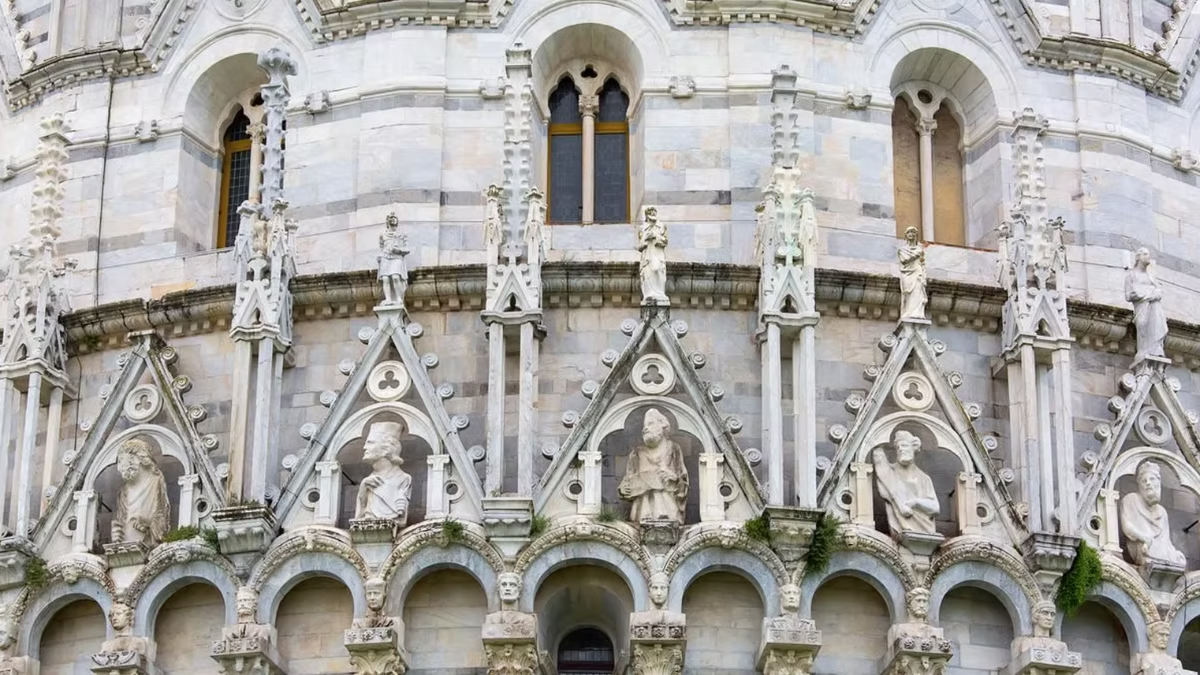
The Leaning Tower of Pisa was never meant to lean. It is the bell tower of the adjacent Cathedral, took 199 years to build, weighs 14,500 tonnes, and contains 207 exterior columns. Its current lean of 3.97 degrees was stabilised by engineers between 1993 and 2001. The Tower has survived at least four significant regional earthquakes — partly because the same soft soil that caused the lean also protects it from seismic damage.
The Leaning Tower of Pisa is one of the most photographed structures in the world, but most visitors know surprisingly little about it beyond its most obvious characteristic. Behind the famous tilt is a story that spans nearly nine centuries — involving medieval wars, accidental engineering, a famous scientist, and a modern rescue mission that cost €30 million. Here are ten facts that go beyond the photograph.
Fact 1: It Was Never Meant to Lean
The Leaning Tower of Pisa was designed to be a perfectly straight, vertical bell tower — the campanile of the adjacent Cathedral of Santa Maria Assunta. The lean was entirely unintentional, caused by the soft alluvial soil beneath the south side of the foundation settling faster than the north side as the tower’s weight increased during construction. By the time builders reached the third floor in 1178, just five years after construction began, the tilt was already visible and measurable. What is now the Tower’s defining characteristic began as an engineering failure.
Fact 2: Medieval Wars Accidentally Saved It
When the lean became apparent in 1178, construction halted. Pisa was almost continuously at war with Genoa, Lucca, and Florence for the next century, and the tower stood incomplete at three storeys for approximately 94 years. This enforced pause — entirely unplanned — turned out to be the Tower’s salvation. The soft soil beneath the foundations had time to consolidate and compress under the weight of the partially built structure. Engineers studying the Tower in the 20th century concluded with near-certainty that without these interruptions, the Tower would have toppled before it was finished. The wars that halted construction inadvertently gave the ground time to strengthen.
Fact 3: The Tower Is Not a Cylinder — It Has a Curve
When Giovanni di Simone resumed construction in 1272, he built the upper floors with one side slightly taller to compensate for the lean. This introduced a subtle banana-shaped curvature into the tower’s profile — most visible from the north or south side. The Tower is not a simple tilting cylinder.
Because the lean was already significant when construction resumed in 1272, the architect Giovanni di Simone attempted to compensate by building the upper floors with one side slightly taller than the other — essentially tilting the new construction back against the lean. This strategy did not correct the overall tilt, but it did introduce a subtle banana-shaped curvature into the tower’s profile. The Tower is not a simple tilting cylinder; examined carefully from certain angles, the upper floors curve slightly in the opposite direction from the lean. This curvature is one of the Tower’s lesser-known structural features.
Fact 4: It Is the Bell Tower of the Cathedral Next Door
The Tower is not a standalone monument — it is the campanile (bell tower) of the Cathedral of Santa Maria Assunta, which stands immediately adjacent to its west. This is why it is architecturally called the Tower and not a monument in its own right; it was designed to serve the Cathedral complex. The Tower’s seven bells were intended to ring out the hours and summon the faithful to mass. They still operate today via an electronic system, ringing before Cathedral services and at noon. The bells are named after the seven notes of the musical major scale: Assunta, Crocifisso, San Ranieri, Dal Pozzo, Pasquareccia, Terza, and Vespruccio. The oldest bell — Pasquareccia — was cast in 1262; the largest — Assunta — was added in 1655 and weighs 2.5 tonnes.
Fact 5: It Has 207 Exterior Columns
The Tower’s exterior is composed of eight storeys (including the belfry) encircled by open-air arcade galleries supported by columns. The ground floor has 15 marble arches forming a colonnade; each of the six middle floors has 30 arches; the belfry chamber has 16. This gives a total of 207 exterior marble columns arranged in the characteristic colonnaded loggias that distinguish the Tower’s Pisan Romanesque aesthetic. Each column capital is individually carved — no two are identical. The columns are made of white Carrara marble and grey marble, the same materials used across Piazza dei Miracoli.
Fact 6: The Tower Has Survived Multiple Major Earthquakes
The Tower has survived at least four significant regional earthquakes since 1280 without structural damage. The same soft soil that caused the lean protects it seismically: the soil’s properties create a resonant frequency that doesn’t match regional earthquake ground motion — a phenomenon called dynamic soil-structure interaction.
Pisa has experienced at least four significant regional earthquakes since 1280. The Tower has survived all of them without structural damage — a fact that puzzled engineers for centuries, given that a 14,500-tonne structure leaning at nearly 4 degrees on a shallow foundation might seem inherently vulnerable. In 2018, a team of 16 engineers published research explaining why. The same soft alluvial soil that caused the lean also protects the Tower from earthquakes through a phenomenon called dynamic soil-structure interaction: the height, weight, and stiffness of the Tower, combined with the specific properties of the soft soil, create a resonant frequency that does not match the frequency of regional seismic ground motion. The Tower does not vibrate in sympathy with the earthquakes. Had it been built on hard rock, it might well have collapsed in any one of those tremors.
Fact 7: It Took 199 Years to Build
Construction began on 9 August 1173 and was completed in 1372 — spanning three major construction phases separated by two long pauses caused by wars. The first phase (1173–1178) reached three storeys before halting. The second phase (1272–1284) brought the structure to seven storeys before another war stopped work. The third phase (1319–1372) added the seventh floor and the belfry. The total construction time of 199 years means the Tower spans the entire arc of medieval Italian architectural development, from the pure Romanesque of the 12th century to the Gothic belfry added in the 14th — which is why the belfry has a different character from the lower storeys.
Fact 8: Mussolini Made It Lean More
In the 1930s, Benito Mussolini considered the Tower’s lean an embarrassment to Italy’s image and ordered it to be straightened. Workers injected 90 tonnes of concrete into the foundation on the south (low) side. The intervention was a disaster. Rather than stabilising the foundation, the additional concrete weight on the soft soil caused the Tower to lurch further in the direction of its lean. By 1990, the tilt had reached 5.5 degrees — more extreme than at any previous point in the Tower’s history. Mussolini’s attempt to fix the Tower made it significantly worse.
Fact 9: The Rescue Cost €30 Million and Took Eight Years
Between 1993 and 2001, engineers extracted 38 cubic metres of soil from beneath the north side of the foundation, reducing the lean from 5.5 to 3.97 degrees. Steel cables and 870 tonnes of lead counterweights provided stabilisation during the most delicate phases. The Tower was declared safe and reopened in December 2001.
By 1990, the lean was increasing at 1–1.2 millimetres per year and engineers warned the Tower was on a path to collapse within decades. Following the collapse of the Civic Tower of Pavia in 1989, which killed four people, Italy closed the Tower to the public and assembled an international team of geotechnical engineers. Their solution — developed and implemented between 1993 and 2001 — was to carefully extract approximately 38 cubic metres of soil from beneath the north (high) side of the foundation, allowing the Tower to settle back slightly toward vertical. Steel cables wrapped around the third storey and lead counterweights provided temporary stabilisation during the most delicate phases. The project cost €30 million and successfully reduced the lean from 5.5 degrees to 3.97 degrees. Engineers estimate the Tower is now stable for at least 200–300 years.
Fact 10: It Is Not the Only Leaning Tower in Pisa
Pisa has other leaning towers — several medieval bell towers in the city centre lean noticeably due to the same soft alluvial soil that tilts the famous one. The bell tower of San Nicola (also attributed to Diotisalvi, the likely original architect of the famous Tower) and the bell tower of San Michele degli Scalzi both lean visibly. The Baptistery in Piazza dei Miracoli leans approximately 0.6 degrees toward the Cathedral. The lean that made the famous Tower a global icon is simply an extreme expression of a condition that affects medieval buildings throughout Pisa. The city itself — its name possibly derived from the ancient Greek word for “marshy land” — was built on ground that has always been, literally, unstable.
Bonus: The Galileo Question
Perhaps the most frequently cited fact about the Tower is that Galileo Galilei dropped two cannonballs of different masses from its top to demonstrate that objects fall at the same rate regardless of weight. It is one of the most famous experiments in the history of science — and it almost certainly never happened at the Tower. The story appears in accounts written after Galileo’s death, not in his own writings. Most historians consider it a legend, or at best an embellishment of real experiments he conducted elsewhere. What is historically documented is that Galileo was born in Pisa in 1564, studied at the University of Pisa, and conducted genuine pendulum experiments in the city — including observations of a hanging lamp in the Cathedral next door. The Tower experiment is the legend; the pendulum experiments are the fact.
Frequently Asked Questions
How tall is the Leaning Tower of Pisa?
55.86 metres (183 feet) on the low side and 56.67 metres (186 feet) on the high side due to the lean.
How much does the Tower weigh?
Approximately 14,500 tonnes.
How many steps does the Tower have?
Approximately 294 (some sources cite 251 or 296 depending on how steps within the belfry are counted).
How many people visit the Leaning Tower each year?
Over 5 million visitors per year to Piazza dei Miracoli; approximately 600 people per day climb the Tower itself (the daily capacity limit).
Is the Leaning Tower of Pisa a UNESCO World Heritage Site?
Yes. Piazza dei Miracoli — including the Tower, Cathedral, Baptistery, and Camposanto — was listed as a UNESCO World Heritage Site in 1987.
How long will the Tower remain stable?
Engineers estimate it will remain stable for at least 200–300 years following the 1993–2001 stabilisation project.
